Tuesday, March 20, 2012

Time to Jump

We've been in Puerto Los Cabos for the last 4 days, doing last minute chores, grading final exams and papers, and waiting for crew. We filled the tanks with bottled water,


changed oil, filters, and transmission fluid, and generally fussed over whatever we could think to fuss over!
Justin and Joseph arrived yesterday, and helped with the last minute provisioning of fresh foods.

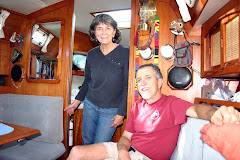
Justin works for the University of Idaho, which explains the "Vandals" flag flying over our heads in the picture. My university didn't give us a flag...
Justin is doing some science education on this passage, and we have a lot of cool scientific and communications equipment onboard, like a BGAN satellite uplink and a FLIR night-vision scope. You can follow Justin's blog at: alatlatequator.wordpress.com

We got our clearance papers this afternoon (after a half-hour of panic when they "lost" our original certificate of documentation, and so now we have officially left Mexico.

The actual departure will come at first light tomorrow. We're hoping for fair winds and following seas!

Saturday, March 17, 2012

Last stop in Mexico

After 11 days traveling along the coast, we've arrived at San Jose del Cabo, our last stop in Mexico before jumping off for the Marquesas next Wednesday. We spent 6 days at various anchorages on Isla Espiritu Santo, then stopped at Isla Cerralvo, Bahia de los Muertos, and los Frailes on our way south. We hiked, snorkeled and kayaked, ran into old friends and made some new ones.


It was great to be finished (at least temporarily) with boat chores and away from the city (as much as we like La Paz). The highlights for me were the deserted sandspit on Isla Cerralvo, a fair-weather anchorage if ever there was one; the school of 500 common dolphins we saw near Los Barriles; and sharing the anchorage at Frailes with 3 other "puddle jump" boats: Buena Vista, Picara, and Chapter Two. Don and Deb gave us our Pacific Puddle Jump burgee, which we are now proudly flying. Thanks to Latitude 38!

Over the course of the week we saw a dozen whales and countless manta and mobula rays leaping out of the water. Despite all the fishing pressure, there is still a lot of sea life here.

Here at San Jose we are tied up next to Wondertime, a young family from Seattle with a 3-year-old and a 6-year-old onboard. They are leaving the dock today, headed for Hiva Oa.

Monday, March 5, 2012

Cruising again


(thanks to Keith and Donna of s/v Victoria Dos for this picture of us leaving the dock)

After more than 2 months in the marina, we are cruisers once again! Provisioning and other preparations for the Puddle Jump are now complete, except for last minute items such as fresh food. We left the dock at Marina Palmira for possibly the last time, at least in this boat. After motoring out to the harbor entrance, we shut off the engine and raised sails in a light NW breeze. We had an absolutely wonderful sail all the way to Bahia San Gabriel on Isla Espiritu Santo. After anchoring, we put the dinghy in the water, went to the beach, and had a great beach walk. There is only one other boat here, anchored at the far end of the bay.
It is great to be back on the water, and in such lovely surroundings.

Sunday, March 4, 2012

Provisioning for the Puddle Jump


Vicki has been hard at work planning, purchasing, and stowing the food we will need for our passage to the Marquesas, which is now less than 3 weeks away. This means a big shift in our diet. While we've been in La Paz, we've enjoyed plenty of fresh fruit and vegetables, including a fair amount of locally grown organic foods. There are plenty of shopping choices nearby, and we can pick up whatever we want whenever we want it. Plus, there is a tremendous selection of affordable prepared food. There is little incentive to prepare lunch when we can get a tasty fish taco for a little over one dollar.
The passage will impose a number of limitations on us. We won't be able to shop for at least 3 and possibly 4 weeks. We have a very limited amount of freezer space. We may not have enough power to run our refrigeration enough to keep things frozen anyway. We have a limited supply of propane for cooking. Conditions at sea may be too rough for complicated meal preparation. We have a limited amount of stowage; not only do we have to find room for food, but we have to carry all plastic trash onboard until we get to the next landfall.
Based on these limitations, we find that we are loading up on a lot more canned food than we are used to eating. Of course, we have a lot of dried foods too. We'll also stock up on fresh provisions at the last minute, but we have to account for the possibility that much of the fresh produce will not survive for more than a week or two.
Many books have been written on the subject of provisioning, and every cruising boat approaches this challenge in a different way. We hope our plan will provide adequate and reasonably tasty meals for the duration of the passage.
Big thanks to Vicki who has worked so hard on this, even though she will not be along for the ride.

Sunday, February 26, 2012

Allá en el rancho grande

Today our friends Memo and Hefziba took us to visit the family's ranch, down near San Juan de los Planes. It was an easy and pleasant drive over the hill, with Isla Cerralvo off to port. And then we left the pavement...

The desert vegetation here is really something. Some of the cardon cactuses must have been 60 feet high and 3 feet in diameter. Eventually we came to the edge of the plain and started winding up into the hills, until we came upon this vista.

At this point we were already on the ranch, which is 1000 acres in size. But we had to cross this canyon to reach the ranch headquarters, up high on the opposite ridge. You might be able to see a splash of green from the trees planted around the ranch house.

Finally we arrived, and Doctor Ruiz, Memo's father, proudly showed us around. He has been planting trees here for the past 18 years that he has owned this ranch.

There were date palms, papayas, mangos, guavas, avocados, zapotes, peaches, a variety of citrus trees, and a few trees I had never seen before. Here is Vicki, breathing in the fragrance from the orange tree blossoms.

Water arrives here through a black plastic hose, 2.5 kilometers long, from a spring high on the nearby mountain. Memito, between his two grandfathers, enjoyed tossing lemons into the cistern.

After squaring away some business with the ranch hand, Memo set to work preparing lunch for all of us.

He is an excellent cook, and the marinated asada tacos were some of the best we have ever tasted. Here we are feeling sleepy after tacos and beer.

There are only about 100 head of cattle here. I asked Doctor Ruiz how many hectares it takes to support one cow. The answer: 35 (over 80 acres). These cows are happily chowing on sorghum hay that was brought up from the irrigated farms back at San Juan de los Planes.

This was another great side trip, and we are grateful to our Paceño friends for showing us their beautiful ranch!

Friday, February 24, 2012

Carnaval and a sideshow

Puddle Jump preparations are well in hand, so we've had time to get out and play a bit. For much of the past week, La Paz has been celebrating Carnaval. It's no Rio or New Orleans, but for a town of this size, we thought it was a very well run festival. The malecon was closed to vehicles, and a mile-long strip of food booths and stages was set up. Being the aging gringos that we are, we tended to go out early and come home early. We never even saw any of the headline musical acts. The highlight for us was the parade, which ran for the last 3 days of Carnaval, going in different directions each day. There were some great floats, good bands, and beautiful people.

On Fat Tuesday, we took a local Mexican family out for a ride on the boat. None of these folks had ever been on a sailboat before, so we were anxious that they have a good time. Things started out well enough - we spotted a pod of dolphins within minutes of leaving the marina. This was the first time we had ever seen dolphins in the bay. I had the family's 4-year-old son help me steer the boat, and he really enjoyed it.

After a downwind run past town, we furled the sail, headed over to the Mogote, and dropped the anchor for lunch.

After lunch, we were motoring back across the bar separating the mogote from the main channel when we suddenly ran aground! I tried to reassure our guests that "there's nothing to worry about, we do this all the time", while Vicki got on the VHF and asked for help from anyone in the area.
In the usual cruiser fashion, we soon had a flotilla of dinghies speeding to our rescue. Led by Rob and Kim on Keetya I, a group of three dinghies pulled on our spinnaker halyard, to heel us over and hopefully raise the keel out of the mud. Another dinghy pushed against the side of our bow to get us pointed down-current. The tide was ebbing and we didn't want to waste any time! Luckily we came free after a few agonizing minutes. As far as I know, there were no incriminating pictures taken! Our guests were a bit more wary but apparently not too badly shaken by the experience. I dove to inspect the keel the next day and all I found were a few spots where the paint had been worn off by the mud. All's well that ends well, thanks to our fellow cruisers.

Saturday, February 18, 2012

One more month until the Puddle Jump

We have spent most of this winter tied up to a slip in La Paz, unlike the past two seasons where we freely roamed the coast of Mexico. Partly this was to accommodate some of the land-based excursions we've already described, but the main reason was to prepare the boat for a 3000 mile passage to French Polynesia.

Last year we went to the Marquesas as crew on another boat, as a way to help us decide whether we really wanted to commit ourselves and our boat to such a long trip. Chances are good that once Southern Cross leaves the coast of North America, she will never return. We will return, of course, but to get the boat back requires too much upwind sailing for our liking, or a ride aboard a Dockwise freighter, which is way out of our budget.

Anyway, we have decided to go ahead with this plan, although many mornings we wake up and ask ourselves "just why the heck are we leaving Mexico?" It has been a wonderful experience living and sailing here, and we know we will be back, with or without a boat.

Vicki has worked hard to prepare for this trip, but she decided long ago that she doesn't need to repeat the passage itself. She will be happy to drive our truck north, then take an airplane to meet me and the boat at Nuku Hiva. I have asked a longtime friend and experienced crewman to join me, and Joseph has invited one of his good friends to become the third member of our company. Justin, a researcher at the University of Idaho, will use this experience to kick off a project called "Adventure Learning at Latitude." Using a BGAN satellite terminal, we'll upload details of our passage, photos, and our observations of the marine environment to a website for elementary and secondary students back home. I'll post a link to the website once it has launched.

Vicki and I have worked hard this winter installing new lifelines, steering cables, shade cloths, and other needed touches, and researching all the information we will need for this next phase of our voyage. All that remains are the usual routine maintenance procedures we would be doing anyway, provisioning the boat with as much food as we can pack into her, and sailing down to Los Cabos to pick up our crew.

We're still a few weeks away from this last step, mostly because I'm tied in to the academic calendar. We anticipate leaving La Paz about March 13, and shoving off from San Jose del Cabo on March 21, right after I've finished grading papers.