Sunday, July 14, 2013

Tonga to Fiji, Day Three

During our morning radio schedule with Sorceress, we agreed that the previous night had been one of our least favorite passages. But we were closing with our approach waypoint and hoped to get some shelter from the confused seas once we were among the Lau Islands. Sorceress had decided to bear off for a better ride and would find a different route from here.
 By ten we could see several islands ahead of us. Our pass was to the north of Katafage island, a route used by another vessel in 2002, but we had also been warned by many others to watch for uncharted dangers throughout Fiji.
 Thus we were hypervigilant as we approached the pass. We could see breakers on the barrier reef to our left, but the heavy overcast made it impossible to see any shallows once we had entered the calmer waters in the lee of Katafage. While sailing in these calmer waters we were able to go forward and properly stoe the main and to check on the condition of the boat and gear. Everything looked fine, so we carried on to the next waypoint, still with no main and only a small fraction of our genoa.

With less confused seas our speed was much greater, and we realized with some relief that we would be clear of all but one of the dangers by nightfall. About 8pm we made the turn at Vatuvara island and bore off toward Savusavu.
We had hoped to be running dead downwind through the night, but the wind had veered to just W of S and so we found ourselves angling across steep seas that periodically broke against the side of the boat, giving us another very wet and uncomfortable night.

Saturday, July 13, 2013

Tonga to Fiji, Day Two

The winds began to fill in at dawn and we were finally able to shut off the engine. What a relief! Our boat has exceptional light air performance, and with only 10 knots of wind, we soon began to pull away from Sorceress. By early afternoon, she had dropped over the horizon. By late afternoon, the wind had strengthened to the point that we reefed the main and partially furled the jib. Just before nightfall, with squalls on the horizon, I put in a second reef. This turned out to be a miserable night. The seas were not large, perhaps 1.5 meters, but very confused, making the motion of the boat quite uncomfortable. Rain was heavy, and we got soaked standing watch, even hunkered down in the companionway. The wind increased up to 30 knots, with higher gusts, and I was forced to drop the main entirely. Our Hydrovane wind vane will not work with only a headsail. The only consolation was that our old mechanical autopilot, an Autohelm 4000, did function, and uncharacteristically, it kept on working through the night. We were very thankful that we did not have to steer by hand in these conditions!

Friday, July 12, 2013

Tonga to Fiji: Day One

Another multi-day passage - lots of time to think. One thing I have been mulling over on my first night watch  is the paradox of cruising under sail in a relatively small boat like ours. In one sense we are enjoying more freedom and independence than almost anyone else on the planet. We can go where we want, when we want. The nightly roll call on the Pacific Seafarers' Net (a ham radio network of volunteers on shore who keep track of sailors' locations and let the authorities know if someone comes up missing) proves this point. At any given time (except during cyclone season) there are boats heading north, south, east, west, and all directions in between. There are far more destinations than there are boats.

While far out to sea we are for all practical purposes beyond the reach of all governments and laws. Our passports are stamped with an exit permit from our last port of call, and we are men and women without a country - at least for awhile.

The paradox is that while independent, we are in another sense quite powerless. Even with satellite sensors and sophisticated computer algorithms, we are still completely at the mercy of the weather. At home, we can shelter from the wind and rain in our buildings and cars. We can turn the thermostat up and down. In a small boat like ours, we have to take it pretty much as it comes.

We left Tonga with the latest forecast showing 10-15 knots of wind, perfect for a boat like ours (most cruisers prefer more wind). What we got was half that. We could still sail, but not very quickly. We are trying to time this passage so that we arrive at the eastern boundary of Fiji, an area liberally strewn with reefs and shoals and other dangers, during daylight hours. Also, the winds are predicted to strengthen to 30 knots later in the week, and we would prefer not to be out here when that happens. Consequently, we have been motorsailing for the past 18 hours. Too much wind, or too little wind, is what we usually get, or so it seems.

Another aspect of helplessness is the restriction on our movement. A couple of days into a long passage you realize that there is no way to change the channel on this program - you can't get off the boat. The happiest sailors are those who are good at sitting down for long periods, or who can make do with stretchy bands or sit-ups for exercise. Those of us like me and my wife really yearn for a nice long walk, to really stretch our legs. We feel confined aboard a boat during long passages. A 70-year-old woman just completed a nonstop solo circumnavigation, a journey which lasted several months. I can't imagine being confined to my boat for that long. Yet there are those who love it, whose favorite part is the long passages. Good on 'em!

We left Vava'u in company with Barb and Sieg on Sorceress. It's nice to have a "buddy boat" for a change.

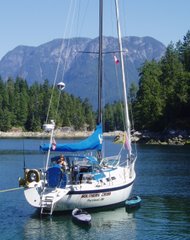
(Here's a photo they took of us, that I edited into the post afterwards) This first day at sea, the winds were lighter than predicted, and we ended up motoring through the afternoon and overnight. We need to time our passage so that we arrive at the eastern boundary of Fijian waters in daylight.

Al through the night, we can see Sorceress's masthead running light behind us, about a mile back.

Farewell to Tonga

We've only been in Tonga about 3 weeks and there is much more we had hoped to see and do. But the weather has not been very good, so we have spent most of the time on a mooring ball in Neiafu. The forecast is for another week of bad weather, so we have decided to move on to Fiji while we have a good weather window for the 3-day passage. Wish we could have swum with whales or visited the Haapai Group...

Monday, July 8, 2013

The South Pacific's "Dirty Little Secret"

(this title is borrowed from Deb and Don on s/v Buena Vista)

 One of the aspects of cruising in the South Pacific that came as quite a surprise to me (Mark) is how much bad weather there is. I'm not talking about high winds, although there are plenty of those. I'm talking about overcast and rain.
 Our previous tropical sailing was done in the Caribbean and on the Pacific coast of Mexico. We'll leave Mexico out of this discussion, as it has endless sunny days and not enough wind for most boats. In the Caribbean, we got used to nightly rain showers and round the clock tradewinds. But days were mostly sunny, and on most days the weather was good enough to sail or for other activities such as snorkeling.
 We knew things were different in the South Pacific when we made our first passage here (crewing on another boat) from Mexico in 2011. Most nights were overcast. I kept wondering "how could the ancient Polynesians navigate by the stars when they are so seldom visible?"
 Another surprise was how confused the seas are, regardless of wind strength and direction. Coming from the Pacific Northwest, we are no stranger to rough seas, but written accounts of tradewind passages had led us to expect a much smoother ride in the South Pacific. Far from it - it is always "one hand for the boat, one hand for yourself."
Swell height is rarely more than 3 meters, but there are usually swells from multiple directions, and with wind waves on top, this can make for an extremely rough ride. We used to think we had a pretty dry cockpit, but we have had several days this season where we had to keep hatchboards in and the hatch closed, even with only 20 knots of wind.
 Last year (2012)  was our first full season in the South Pacific, and except for the passage from Mexico, I would describe the weather as "good" by the standards of the Caribbean. Especially in the Tuamotus, we had many sunny days, and we usually did not have to wait long for a weather window for passage-making. 
This year, as we have moved farther west, things have changed. Although I have not kept an accurate count, I would say that most days are overcast. I can't remember any period of sunshine lasting longer than a couple of days. We have had numerous extended periods of heavy rain - heavy enough to fill our water tanks in a couple of hours by leaving the fill caps open and putting a "dam" of toweling at the downhill side. Heavy enough that I have had to bail out the dinghy every few hours.
The winds have not been too surprising. We had read that tradewinds are stronger as you head west, and we have found this to be the case. Tradewinds are often 25 knots or greater, which is right at the upper end of our boat's abilities. We need to fly the main when using our wind pilot (Hydrovane) - it won't steer the boat under jib alone. But with only 2 reefs, we can't fly the main in much more than 25 knots. So while heavier yachts wait for a "weather window" of 25 knots or more, we wait for a weather window of 25 knots or less. 
We've been in the Vava'u islands in Tonga for a little over 2 weeks now. While we had good weather the first week, the second week brought steady winds of 25 knots or higher, making most of the anchorages outside of Neiafu uncomfortable by our standards. We just spent three days in the bay between Vaka'eitu and Lape Islands. The boat was pitching hard enough to make the V-berth unuseable. On our way out of Lape yesterday, we got hit by blinding rain and 40-knot gusts. At one point we could not motor directly to windward - we had to tack back and forth until the wind subsided. Friends who had pulled out 10 minutes after us were forced to turn around and head back to Lape.
We had planned to head south to the Haapai group this week, but after experiencing yesterday's squall in the relatively protected waters of Vava'u, we have cancelled that plan. So now we're back in Neiafu, one of the most protected anchorages in the South Pacific. The winds have died, as far as we can tell, but it's raining, as it has been for the past 5 days, and the dinghy needs bailing for the 3rd time in 24 hours. Yep, we're in the good ol' South Pacific Convergence Zone!

Sunday, July 7, 2013

Lape Island

In our first week in Vava'u, we had already attended two "Tongan feasts." Nevertheless, we decided to attend a third feast, hosted by the small island community of Lape. The 5 families living here have made a conscious decision to embrace the yachting community. They have installed 5 moorings near the village. They hold traditional Tongan feasts every 2 weeks, and also sell traditional handicrafts. They do not charge for the feast or moorings, but ask for donations. The money received goes for community improvements, such as a concrete path from the village to the wharf, school supplies, and a modern septic system.

We arrived a day early, and decided to visit the neighboring island of Vaka'eitu. The resort mentioned in our guidebooks was nowhere to be seen, and we later learned that it had closed several years ago after the owner's death. There were several small kids playing on the beach, so we dinghied ashore to see if they could tell us where to find the trail to the other side of the island. Soon we were off tramping through the jungle, led by Kaho, Kava, Ana, and Rosaline. Their mother told us that she has 11 kids altogether, ranging in age from 1 to 20.
 

The next day we moved over to Lape Island, and decided to visit the village before the feast. As in other villages we have visited, Lape has solar panels and storage batteries for each house, courtesy of Japan.
 
Lape also has a nice schoolhouse and a well-trained teacher, even though there are only eight students in grades 1-6 (secondary students must got to Neiafu).

 In one home several people were at work preparing for the feast, making leis and other craft items.

As time approached for the feast, dinghies began to arrive at the wharf. I didn't get a precise count, but there were at least 34 people from 13 different yachts, mostly from Australia, New Zealand, and North America.
 
 Vicki bought several woven items from the craft booth.
 
 Tola, one of the village elders, holds Miles, one of the youngest cruisers at this week's feast.
 In front of the schoolhouse, Kolio showed us how items were made from local materials. Some of the woven items last a very long time, and are even passed down from generation to generation.
 

The next day, we went snorkeling on a nearby reef, with some of the healthiest and most diverse corals we have ever seen.
 

Monday, July 1, 2013

Hanging out in Neiafu

High winds are making the out-island anchorages untenable, so we're spending a few days hanging out in Neiafu. This has given us the opportunity to experience some of the local culture. As religion plays a dominant role in Tongan society, we decided to attend a church service. We selected the large Catholic church near the anchorage, because we heard they had an excellent choir.

We were not disappointed! We put on our best clothing and arrived early enough to be seated right behind the baritones. Wow, they could really belt it out.

The next day, there was a feast to honor the new bishop, and we were allowed to attend. In fact, we were treated very hospitably, considering we are not church members. There were long tables, organized by families and neighborhoods, and each one was heaped with an amazing array of foods, including things that to us were quite exotic, such as several varieties of lobster and crab. Ironically, the locals seemed most drawn to the packaged foods!


After the meal, a number of groups honored the new bishop with singing and dancing.