Saturday, August 17, 2013

Namena

After our day in "Paradise" we were ready for more adventure. Winds were favorable, so we decided to make a 45-mile passage across the Koro Sea to the marine reserve at Namena. This offshore reef system has some of the best soft coral and most diverse fish life in all of Fiji. We called ahead to make sure that the single mooring ball was available, and asked if they would take us diving. Although the small resort here does not normally accommodate non-guests, it has recently come under new management, and they agreed to take us diving, since none of this week's guests were divers. This was lucky for us, as sea conditions were too rough for us to dive from our dinghy. We dove the same two dives two days in a row: "Grand Canyon" and "Chimneys." After seeing this arch, I thought they should have renamed this dive "Canyonlands" or "Arches." The soft corals here were even better than what we had seen at the Rainbow Reef last week. Fish life was abundant and very diverse. We noted at least a dozen species that we had never seen before, including walu (Spanish mackerel). One of the highlights for which I have no picture was taking my regulator out and positioning my open mouth in front of a cleaning station. Several cleaner shrimp stepped gingerly onto my lower lip and went to work like dental hygienists! Couldn't hold my breath long enough for the full treatment, so I guess I'll have to schedule another appointment. We took a short walk on the end of the island after our dives were finished. There were some amazing trees here.

Wednesday, August 14, 2013

Paradise

It had been a great week at Viani Bay, but we needed to stock up on a few supplies, so we sailed back across the Somosomo Strait to the island of Taveuni. I rowed Vicki ashore, where she could catch a taxi to the supermarket, while I kept watch aboard the boat in case of a change in the weather or a problem with the anchor. After she returned, we headed for the south end of the island and a completely different experience. Based on recommendations from our friends on The Rose and Legacy, we decided to pick up the mooring in front of the small Paradise Resort. The owners, Allan and Terri, gave us a warm welcome and encouraged us to enjoy the resort's amenities, including pool, restaurant, dive operation, and lovely grounds. The next morning, Vicki had a nice massage at the waterfront bure, while I returned for a second visit to Nabogiono Farms, only 3km down the road. Bobby agreed to show me the parts of his farm that we had missed the first time around, including his eco-friendly farming operation and a patch of primary rainforest toward the upper end of his property. While we didn't see as many birds as on the first outing, it was very interesting to learn about the wide variety of plants that Bobby tends, both natural and horticultural species. For example, I got to taste cocoa beans (you just suck the outside of the bean, the bean itself is bitter until processed), and heart of palm. This was the first time I had seen kava being grown. It takes from 3 to 5 years before it is ready to harvest. Here's a fiddlehead on a tree fern. At the end of the tour, Bobby invited me to lunch with his wife Jiu. It turns out she is originally from Vanua Balavu, one of the more remote islands that we had visited a few weeks ago. On our way back to the resort, Bobby showed me this enormous raintree that local villagers had attempted to cut down. He stood up to them in protest, as it was the last large tree along this section of the highway, and they had grudgingly backed down. This was a poignant reminder of the challenges Fiji faces in conserving its precious natural resources. Hopefully more people like Bobby will become involved with conservation and sustainable practices.

Saturday, August 10, 2013

Viani Bay

We had come to Viani Bay two weeks ago, but a southwesterly wind had caused us to leave before we had experienced any of its charms. We knew we would come back when the weather was better. This anchorage is very popular, for several reasons.
Not only is it a particularly lovely bay, but it is inhabited by some very friendly people. The first person to greet most new arrivals is Jack Fisher, who has done a lot of sailing in his day. Jack enjoys making new friends, helping them explore Viani's delights by both land and sea, and regaling them with his many interesting stories. He also generously provided us with fresh fruits and vegetables while we were in Viani.

We were anchored close to Yanuyanuwiri Island,

inhabited by Jack' cousins Frank and Edward and their families. Frank and his wife Luji rowed past our boat on their way to get fresh water from a nearby spring, and Vicki asked if we could come and visit their island.

We brought a couple of books to read to Frank's younger brother Andrew.

Afterward, we took Andrew out to see our boat. He enjoyed operating the outboard on the dinghy, and was very interested to see the boat's main engine.

Viani Bay has its own primary school, serving about 60 students, manof whom who are ferried to class by boat.

Along with Bob and Ann from Charisma, we visited the fifth and sixth grade class for an impromptu geography lesson. Wish we would have had a map with the Pacific Ocean in the middle, instead of being split in two as on most maps. I'm not sure the students understood exactly how we had gotten from the left-hand edge of the world to the right-hand edge. (ha!)

It was sports day, and we enjoyed seeing the close teamwork among students.

From here, Jack led us on a long hike into the surrounding bush. Once again, I was struck with the size of Fiji's forest trees, like this raintree, and the epiphytes that grow on them.

Jack told us about the beneficial uses of many of the plants we saw. Here's one plant whose stems can be used as a straw (wish we had had a drinking nut on the other end of the straw).

Jack will also guide boaters out to snorkel or dive on the nearby Rainbow Reef. Bob needed to rent gear, so he, Vicki, and I were instead picked up at our boats by a local commercial dive operation.
This is a well-known dive destination, and though we weren't here at the right part of the lunar cycle, we still managed to see some beautiful soft corals.

This blood-red anemone was inhabited by a couple of Fiji anemonefish.

These were the first redtooth triggerfish we had seen since Raiatea.

This spotted unicornfish was less shy than most.

Vicki got to see her first clown triggerfish. What a delightful costume!

The fish were more profuse and varied here than anywhere else. We really hope to return here next season, but this season is winding down and we have to start moving west soon.

Thursday, August 8, 2013

Taveuni

We had a beautiful sail across the Nanuku Passage from Vanua Balavu to Taveuni. We invetigated the harbor at Vurevure, but it seemed a bit too exposed to the southeasterly prevailing winds, and was filled with pearl farm buoys. So we carried on another couple of hours to the northeastern tip of the island, near the town of Matei and the island's principal airport. We had been given the name of a local man who likes to guide cruisers around (for a reasonable fee). We immediately hit it off with Wani, who told us he was the chief of nearby Wiwi village. One of the first places we wanted to visit was the Italian restaurant, where we had heard there was great pizza. Wani told us his daughter Lydia worked there! There is a lot of protected forest on Taveuni, and villagers have developed several ecotourism projects to help generate revenue. This helps to offset some of the income lost by not developing the land, harvesting the forest, or clearing it for agriculture. We were only too happy to contribute to this cause. We hiked a beautiful trail through the forest to two waterfalls. On the way back down, we stopped to admire the view over the reefs, with Qamea Island in the background. We spent the rest of the day shopping for produce and other provisions, and realized we needed at least one more day to see more of this beautiful island. Wani wanted us to see the plaque commemorating the location of the 180th meridian of longitude. While this is the designated "International Dateline" it runs right through Taveuni and the rest of Fiji, so for convenience they observe a single date and time zone throughout the country. Still, the plaque makes for an intriguing stop! We passed a school, and Vicki lost no time meeting some of the local students. We had mentioned to Wani that we were interested in seeing the orange dove and other endemic birds of Fiji. So he drove us down a long and very rough road to reach "Nabogiono Farms" a private estate that the owner inherited from his grandfather. Bobby Shankaran was a delightful and informative guide, filled with passion for conserving the natural resources he has grown up with. He is self-educated, and is constantly researching ways to restore bird habitat, and to derive agricultural outputs and income from the forest without damaging it. We really enjoyed our time with him and hope to return here at some point. Bobby's dream is to develop a "Ridge to Reef" conservation project, and we want to learn more about this project. We could easily have stayed longer on Taveuni, but the weather was changing, and our anchorage at Matei had become a little less comfortable. We decided it was time to seek better shelter in Viani Bay, across the Somosomo Strait.

Sunday, August 4, 2013

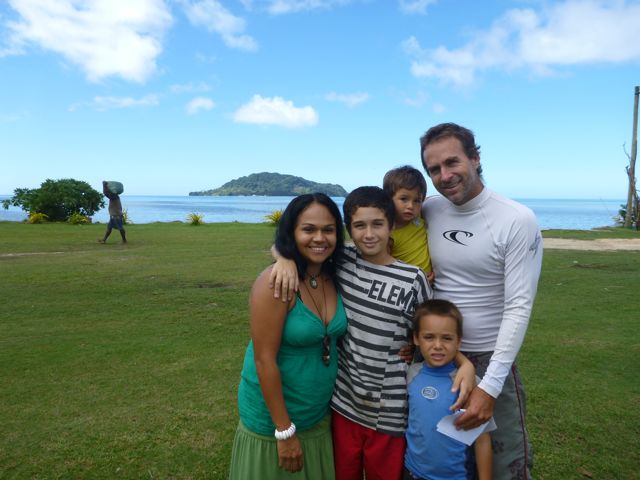
Still exploring...

After having been turned back on our attempt to sail to Fulaga, we decided to explore some other areas on Vanua Balavu. Our first destination was Bavatu, a well-protected harbor on the north coast. Shortly after we arrived, this traditional Polynesian canoe came in from Suva. Crewed by a mix of Fijians and people from other South Pacific nations, Okeanos had been part of the Pacific Voyagers fleet that sailed to Hawaii, San Francisco, down the coast all the way to Panama, and then back to French Polynesia in 2011-2012. One of the main reasons we had come to Bavatu was to hike up to the plantation above the bay, and across the island to a viewpoint overlooking the Bay of Islands. Our next stop, a couple of days later, was the village of Mavana, where we had to offer sevusevu for the privilege of anchoring in their waters and hiking on their land. One of the first people to greet us after we stepped ashore was Tevita, who is originally from here but at one point had been the mayor of Suva. He is one of several important Fijians from this village; the former prime minister and the head of the Methodist Church in Fiji are also from Mavana, and still maintain homes here. And little wonder - it is a truly beautiful spot. Tevita asked us where we wre from, and mentioned that there was another American named Mark living here. After doing our sevusevu, we went to meet Mark, his wife Noemi from Manzanillo, Mexico, and their three children. They have a long relationship with Fiji, one of their kids having been born here. They are preparing to build a house on the neighboring island of Avea, in the left background in the picture. After leaving Mavana, we anchored in a neighboring bay that is called Little Bay by cruisers, but I think the locals refer to it as Raviravi. This was a great spot for dinghy exploration and there was great snorkeling at an off-lying reef, where we saw huge lettuce corals and found this giant clam shell (which we put back after photographing). we were getting low on stores and fuel, so we finally had to head back to a slightly more developed part of Fiji. Our last anchorage was just inside Qilaqila Pass, from where we could make an early departure for our planned crossing to Taveuni. We are grateful for our brief taste of the Lau Islands, and hope we can return to this part of Fiji next year.